The Complexity of Hiring in 2026
Hiring conditions this year are anything but simple.
New data shows widening skills gaps across finance and accounting teams, while firms like PwC are reshaping early-career pathways to adapt to AI’s growing influence.
Together, these shifts point to a hiring landscape defined by rising technical demands, increased competition for specialized talent, and a growing emphasis on upskilling.
Navigating a Hiring Market defined by skills gaps
If there’s one word to describe hiring in 2026, it’s not “simple.” According to a recent report surveying 2,000 hiring managers, businesses are facing more noticeable skills gaps and increasingly complex hiring conditions. In fact, 62% of respondents said skills gaps are more apparent now than they were a year ago.
Finance and accounting teams are feeling the strain in particular. Among leaders in these departments:
- 53% reported that skills shortages have become more evident over the past year
- Key gaps include financial planning and analysis, AI literacy, and automation expertise
- 6% of finance and accounting leaders said they currently have the capabilities needed to accomplish priority projects in 2026
- 57% said upskilling existing employees is necessary
- 61% noted that finding skilled professionals is more difficult than it was a year ago
One factor contributing to the challenge is the widespread implementation of new ERP systems. These upgrades often reveal technical skill gaps within existing teams, prompting companies to seek permanent hires with specialized expertise or bring in contract professionals to support ongoing projects.
Hiring plans reflect this dual approach:
- 56% of surveyed organizations expect to increase permanent headcount in the first half of the year
- 54% plan to add contract or temporary staff
After a slower hiring environment in 2025, market activity began picking up toward the end of the year as companies pushed to meet business goals. That momentum is expected to continue into the second half of 2026, with increased employee confidence likely driving higher movement in the job market and creating additional pressure for companies that lack flexibility.
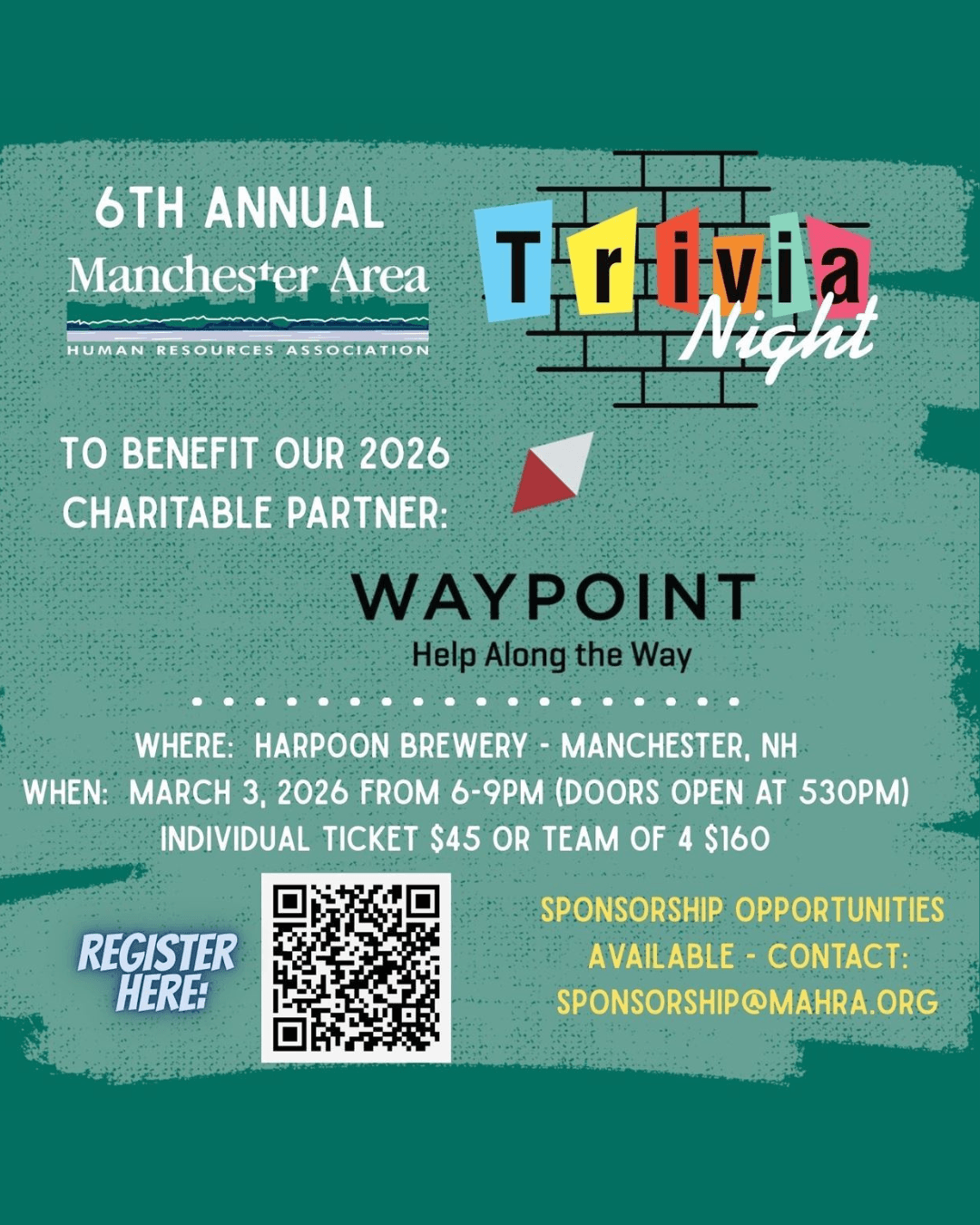
You’re invited to join us for the 6th Annual Trivia Night hosted by the Manchester Area Human Resource Association!
This event has been a blast year after year, and we’re excited that it’s now open to more than just HR professionals. It will be general trivia, so anyone can jump in and have fun.
🗓️ March 3rd, 2026
⏰ 6:00pm – 9:00pm
📍 Harpoon Brewery – Manchester, NH
All proceeds from the evening will benefit Waypoint, a nonprofit dedicated to strengthening individuals and families across New Hampshire.
This Week’s Featured Jobs find your next career move
Controller – Springfield, MA | $150k-$160k/year
Assistant Controller – Springfield, MA | $90k-$110k/year
Staff Accountant – Nashua, NH | $60k-$65k/year
Senior Financial / Business Analyst – N. Billerica, MA | $110k-$125k/year
Payroll Specialist – Boston, MA | $70k-$85k/year
Senior Accountant – Connecticut | $85k-$95k/year
VP of Finance – Boston, MA | $175k-$250k/year
Director of FP&A – Boston, MA | $140k-$180k/year
Senior Revenue Accountant – Boston, MA | $90k-$110k/year
Accounting Manager / Assistant Controller – Woburn, MA | $125k-$150k/year
Director Internal Audit – Billerica, MA | $190k-$225k/year
Senior Internal Audit – Contractor – Wilmington, MA | $45-$62/hour
Senior Payroll Consultant – Billerica, MA | $50-$60/hour
Accounting Policy Manager – Boston, MA | $128k-$166k/year
PwC Reshapes early-career hiring
As companies refine their workforce strategies for 2026, PwC is making notable changes to how early-career consultants begin their roles. The firm recently reduced the number of U.S. office locations available to entry-level hires from 72 to 13, a move designed to foster stronger community and connection among junior employees at the start of their careers. Leadership says the decision reflects a growing focus on intentional talent development as organizations adapt to evolving workplace dynamics.
The shift comes alongside broader investments in AI readiness. PwC has launched training initiatives aimed at building specific AI-related skills and introduced a new career path tailored to engineers. These efforts mirror a wider consulting industry trend: firms are working to incorporate AI tools into daily operations while maintaining the human expertise that clients still rely on. Although AI capabilities continue to advance quickly, they are not yet positioned to replace consultants outright.
One of the most pressing questions centers on how AI should be used by early-career professionals. On one hand, automation can handle repetitive tasks that traditionally filled junior roles, allowing employees to focus on higher-impact work sooner. On the other, bypassing those foundational assignments may create knowledge gaps that could affect long-term professional growth. Industry leaders note that this tension extends well beyond consulting, as organizations across sectors determine how to integrate AI without sacrificing essential skill-building.
Executives emphasize that execution will separate top performers in the coming year, placing greater importance on disciplined planning, clear road maps, and teams measured by results. As companies weigh the speed and efficiency AI offers against the value of hands-on experience, many are recognizing that the real challenge isn’t whether to adopt AI, but how to use it in a way that strengthens both productivity and professional development.
Strategic Moves Start With the Right Partner, and KBW Financial Staffing & Recruiting can be that for you!
