
AI, Accounting, and More on the KBW’s Public Accounting Practice
As artificial intelligence rapidly transforms the accounting industry, firms of all sizes are reimagining how work gets done. From automating audits to delivering real-time insights, AI is helping accountants shift into more strategic, advisory roles. We break down what that means for the profession and the skillsets it demands moving forward.
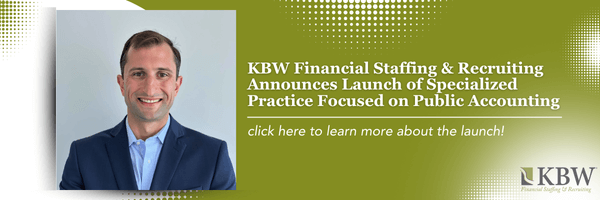
At KBW Financial Staffing & Recruiting, we’re evolving too! In case you missed it last week, we’ve announced the launch of our new Public Accounting Practice, led by Managing Director, Alden Flagg. This practice strengthens our ability to support firms navigating change and helps professionals connect with meaningful career opportunities.
Want to see how salaries are trending in this changing landscape?
This Week’s Featured Jobs: Find your next career move
Senior Accountant – Ashland, MA | $110k/year
Sr. FP&A Analyst – Marlborough, MA | $44-$55/hour
Controller – Bedford, NH | $145k/year
Assistant Controller – Cambridge, MA | $100k-$110k/year
Finance Manager – Manchester, NH | $115k/year
Sr. Manager, Tax – Somersworth, NH | $130k-$160k/year
Director of FP&A, R&D – Cambridge, MA | $230k/year
Controller – Newton, MA | $175k/year
Controller – Manchester, NH | $140k/year
Finance Manager – Manchester, NH | $115k/year
Transforming Accounting Through the Use of AI
Artificial intelligence is no longer just a buzzword in accounting—it’s actively reshaping the profession. Major firms like EY, KPMG, and Deloitte are leading the charge, using AI to improve audit accuracy, speed up data analysis, and provide predictive insights that go beyond traditional number-crunching.
EY’s AI tools review contracts with a level of precision and speed that reduces risk and boosts compliance. KPMG’s Ignite platform and Deloitte’s Cognitive Advantage initiative show how AI is helping firms move from routine work to higher-value, strategic advisory services.
Here are a few standout examples of how top firms are integrating AI into their accounting operations:
Ernst & Young (EY): Uses AI to analyze contracts and documents during audits—boosting accuracy, reducing human error, and improving compliance.
KPMG: Developed KPMG Ignite, an AI-powered platform that provides trend analysis and predictive insights to support strategic client decisions.
Deloitte: Launched the Cognitive Advantage program to automate repetitive tasks and give professionals more time for complex, judgment-based work.
But the transformation isn’t limited to large firms. Smaller accounting firms are also adopting AI tools for tasks like payroll, tax prep, and forecasting—leveling the playing field and giving more businesses access to high-level financial insights. Across the board, this shift is changing what it means to be an accountant: professionals are expected to be more tech-savvy, proactive, and focused on strategic outcomes. AI is enhancing, not replacing human expertise—creating a new kind of hybrid intelligence in the field.
While concerns around privacy and ethical use remain, firms are responding with stronger data governance and responsible AI practices. Overall, the integration of AI is driving efficiency, innovation, and a cultural shift toward continuous learning. The future of accounting isn’t just digital—it’s dynamic, data-driven, and more strategic than ever.

It’s too hot outside to not like your job… we can help you find a new one!
